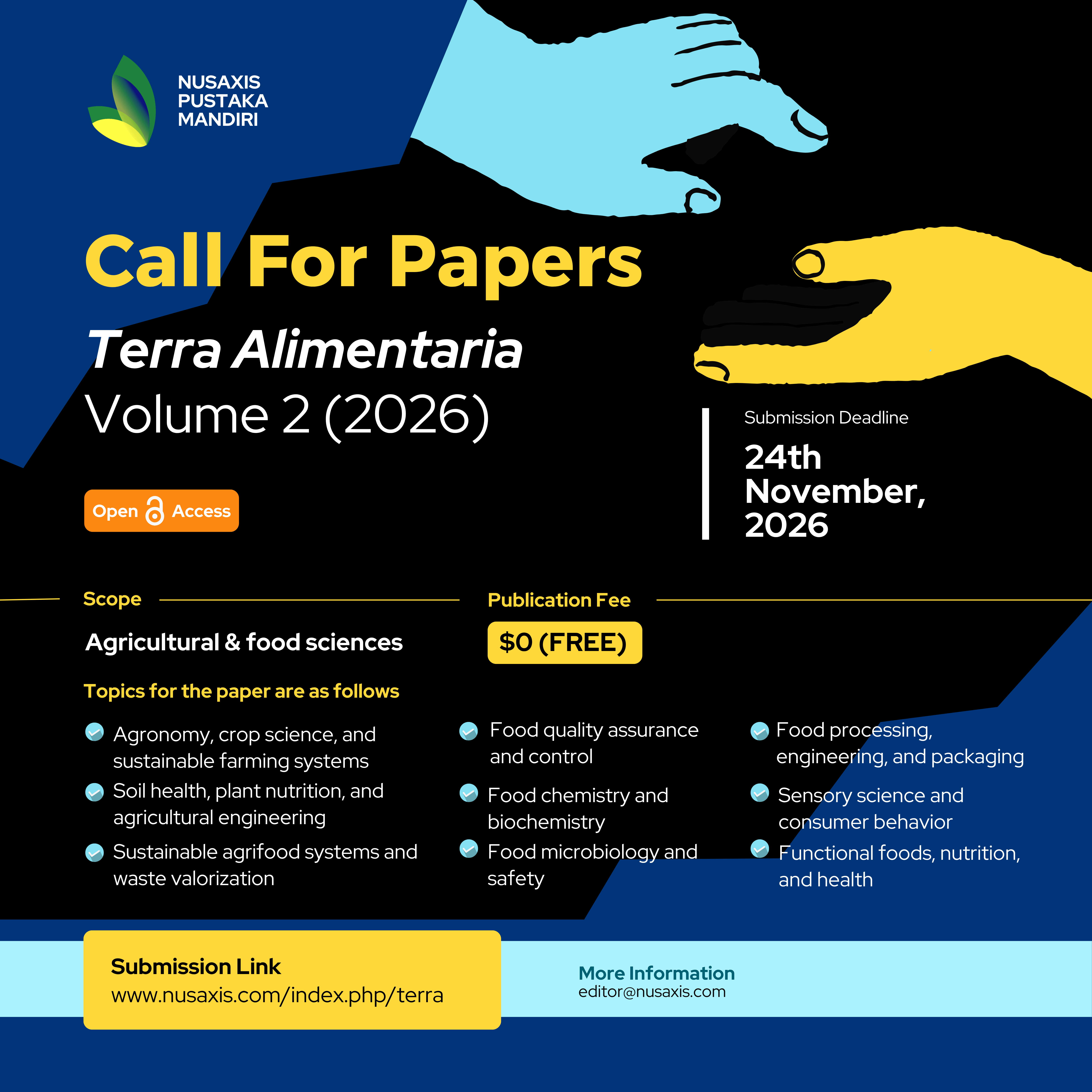
Terra Alimentaria is actively seeking high-quality submissions for our upcoming December 2026 issue.
Terra Alimentaria is dedicated to maintaining the highest standards of professional ethics, accuracy, and quality in all matters related to handling manuscripts and reporting scientific information. Our policies align with the Committee on Publication Ethics (COPE) guidelines and comply with the national journal accreditation standards (Permendiktisaintek No. 9 Tahun 2026 tentang Akreditasi Jurnal Ilmiah).
Ready to submit your research? Please be sure to read the Author guidelines before submitting a manuscript. The manuscript template is provided below.
The aim of Terra Alimentaria is to offer scientists an international forum to publish research at the forefront of food science. The journal publishes peer-reviewed articles covering all aspects of food science, ranging from post-harvest to food technology, processing, and how food science influences health and nutrition. Key findings in multidisciplinary articles must address some aspect relevant to the science of food.
Manuscripts may be judged unacceptable due to the low impact of the findings or inappropriate technical aspects. Manuscripts with experimental designs that are a simple comparison among treatments, without demonstrating mechanistic advances to the science beyond treatment effects, may be returned without review. Research must focus on a food, food ingredient, or byproducts of food production. Studies on traditional medicines, pharmaceuticals, or materials not identified or justified as foods are outside the scope of this journal. Manuscripts covering a very narrow topic with only local interest will not be considered.
Terra Alimentaria is committed to transparent publishing practices. For complete details regarding our current APCs, payment processes, and our waiver policy for authors experiencing financial hardship or from low-income countries, please see our dedicated Author fees page.
Terra Alimentaria welcomes submissions that significantly advance the field of food science, technology, and sustainable food systems. To ensure a streamlined peer-review process, authors must clearly indicate the intended manuscript type upon submission in the OJS platform. The journal considers the following four types of manuscripts:
These are comprehensive, full-length papers detailing novel, original empirical research that represents a significant advancement in the field. The research must be scientifically robust, methodologically sound, and provide new insights.
Review articles should provide an authoritative, in-depth, and critical evaluation of existing literature on a specific, highly relevant topic within the journal's scope. We do not accept mere summaries of literature; reviews must offer a critical synthesis, identify current research gaps, and propose future research directions.
These are forward-looking, thought-provoking essays that present a personal but scientifically grounded viewpoint on emerging topics, recent technological trends, policy shifts, or controversial issues in food science. While they express the author's opinion, all claims must be strictly evidence-based and supported by peer-reviewed literature.
Short communications are brief, urgent reports of highly significant and novel findings that require rapid publication. This format is intended for preliminary results, new models, or innovative methods that do not yet warrant a full-length original research article but offer a major breakthrough to the scientific community.
Authors should identify the most relevant topic area when submitting their manuscript:
Authorship requires meeting ICMJE criteria: substantial contributions to the conception/design or data acquisition/analysis; drafting or critical revision; final approval of the version to be published; and agreement to be accountable for all aspects of the work. Ghost, guest, honorary, or anonymous authorship is strictly prohibited. New authors cannot be added after initial manuscript submission.
The corresponding author must verify that the manuscript has not been published or submitted elsewhere. The editorial team uses similarity detection software (Turnitin/iThenticate). Self-plagiarism or copied text/figures will result in immediate rejection and potential sanctions.
All submissions are screened by the Editor-in-Chief/Managing Editor for scope, language, formatting, and scientific rigor. Terra Alimentaria uses a Single-Blind Peer Review process via the OJS platform. In this model, the reviewers know the identities of the authors, but the authors do not know who reviewed their manuscript. You do not need to anonymize your main document. Please see the Peer review process page for more information.
Manuscripts are assigned to at least two expert reviewers. Authors must provide detailed, line-by-line responses to reviewer feedback during the revision stage.
Acceptance Criteria: Factors include reader interest, relevance to human foods, originality, scientific quality, depth of investigation, proper statistical analysis, and accurate data interpretation.
All manuscripts must include the following sections to provide transparency regarding artificial intelligence use, authorship contributions, funding, data sharing, conflicts of interest, and general acknowledgments.
Nonhuman technologies (e.g., AI/LLMs) cannot qualify as authors. The use of AI tools must be explicitly disclosed in this separate section with its own heading, and not under the Methods and/or Acknowledgments sections. Please see the Artificial intelligence policy page for more information on the use of AI ools. If AI was not used, this section may be omitted. If AI is used for language editing or drafting, authors must use the following statement format:
Example: "During the preparation of this work, the author(s) used Trinka AI (Enago) solely to improve the readability and language clarity of the manuscript. After using this tool, the author(s) reviewed and edited the content as needed and take full responsibility for the accuracy, originality, and integrity of the final publication."
Authors must explicitly state the individual contributions of all authors to the research and manuscript using the Contributor Roles Taxonomy (CRediT). This ensures transparency and accurate attribution of each author's work. All authors must have read and approved the final submitted version.
Example: "Author A: Conceptualization, Methodology, Writing – Original Draft. Author B: Data Curation, Formal Analysis, Software. Author C: Supervision, Project Administration, Writing – Review & Editing. All authors have read and agreed to the published version of the manuscript."
Acknowledge individuals who contributed to the study but do not meet the ICMJE criteria for authorship (e.g., providing general administrative support, writing assistance, or access to specific equipment). Do not include funding information here.
Example 1: "The authors would like to thank Jane Doe for her technical assistance with the HPLC analysis, and John Smith for his valuable feedback during the drafting of this manuscript."
Example 2 (If no acknowledgments): "The authors have no additional acknowledgments to declare."
All authors must disclose any financial or professional affiliations (within the past 3 years) that might be perceived as a conflict of interest or could have appeared to influence the work reported.
Example 1 (No conflict): "The authors declare that they have no known competing financial interests or personal relationships that could have appeared to influence the work reported in this paper."
Example 2 (Conflict declared): "Author A receives research funding from [Company Name]. Author B serves as a paid consultant for [Company Name]. The remaining authors declare no conflicts of interest."
Identify all sources of financial support for the conduct of the research and/or preparation of the article. Provide the name of the granting agency and the specific grant number.
Example 1: "This work was supported by the Ministry of Education, Culture, Research, and Technology of the Republic of Indonesia under Grant [number XXXX]."
Example 2 (No funding): "This research received no specific grant from any funding agency in the public, commercial, or not-for-profit sectors."
Authors must provide a statement detailing where the data supporting their findings can be found. Terra Alimentaria encourages the deposition of datasets in recognized public repositories.
Example 1 (Public repository): "The datasets generated and analyzed during the current study are available in the [Repository Name] repository, [Insert Link/DOI]."
Example 2 (Available upon request): "The data presented in this study are available on reasonable request from the corresponding author. The data are not publicly available due to [state reason, e.g., privacy/ethical restrictions]."
Example 3 (No data): "Data sharing is not applicable to this article as no new datasets were generated or analyzed during the current study."
Proper statistical analysis is mandatory. Studies must comprehensively describe experimental design (e.g., completely randomized, mixture, factorial).
A minimum of three true replicates of independent laboratory observations is required. Repeated sampling from the same batch (pseudo-replicates) reflects measurement variance, not experimental variance, and is unacceptable.
Mean values must be accompanied by a measure of variability (Standard Deviation, SEM, or 95% Confidence Interval). Significant digits must match instrument precision.
State the α-value used to reject the null hypothesis (usually α ≤ 0.05 or 0.01). Data must be checked for normal distribution (e.g., Shapiro-Wilk) and homoscedasticity/equality of variances (e.g., Levene’s test). If data are not normally distributed, use non-parametric tests (e.g., Mann-Whitney) or apply data transformation.
For ANOVA, if significant differences are found globally, a post-hoc test (e.g., Tukey’s, Duncan’s) must be applied to determine specific sample differences. Statistically significant differences must be indicated in tables/figures with superscript letters or markers.
For Response Surface Methodology (RSM) or linear regressions, measures of fit (R², adjusted R², RMSE, p-values) must be reported. Optimization procedures must be validated using an external combination of factors not tested in the original design.
Multivariate models must include appropriate measures of fit (e.g., eigenvalue cut-offs). Factor loadings and the percentage of variance explained by each factor must be reported.
Use the APA 7th Edition Author-Date format. Cite only necessary publications and prioritize primary references. We highly encourage authors to use Mendeley reference management software with the APA 7th Edition style installed to automate and ensure the accuracy of citations and reference lists.
Non-specific spectrophotometric determinations are insufficient. Validated chromatographic methods (HPLC, MS, NMR) must characterize bioactive composition. Chemical antioxidant activity should ideally be supplemented by cell-based or in vivo methods.
Use the International System (SI) units strictly. Additional sections for "Notations" (symbols and subscripts) and "Theoretical Considerations" are permissible following the Abstract and Introduction, respectively.
Bacterial and fungal nomenclature must conform to approved taxonomic lists. Explicitly describe culture conditions, media, and handling methods. Nucleotide or amino acid sequences must be submitted to public databases (e.g., GenBank) and accession numbers provided.
Animal models must have demonstrated relevance to human nutrition. Avoid high pharmacological doses unattainable by regular food consumption. Complete diet compositions and strain/source of animals must be described. In vitro studies predicting human processes must correlate with in vivo mechanisms.
IRB/Ethics approval and informed consent are strictly required. Consumer tests require a minimum of 75 participants. Trained panels require at least 8 panelists with documented training and reliability. The study must include or cite a lexicon. Clinical human intervention studies must adhere to CONSORT guidelines.
Terra Alimentaria is actively seeking high-quality submissions for our upcoming December 2026 issue.

Terra Alimentaria is published by Nusaxis Pustaka Mandiri LLC.
Office: Perum Grand Handayani Residence Blok BB19, Gunungkidul, Special Region of Yogyakarta, Indonesia, 55651.
© 2026 Nusaxis Pustaka Mandiri LLC
NIB: 0202260114803 | Legal Entity No: AHU-007750.AH.01.30.Tahun 2026
(Registered with the Ministry of Investment and Downstream Industry & the Ministry of Law and Human Rights of the Republic of Indonesia)

Content is licensed under a Creative Commons Attribution 4.0 International License.