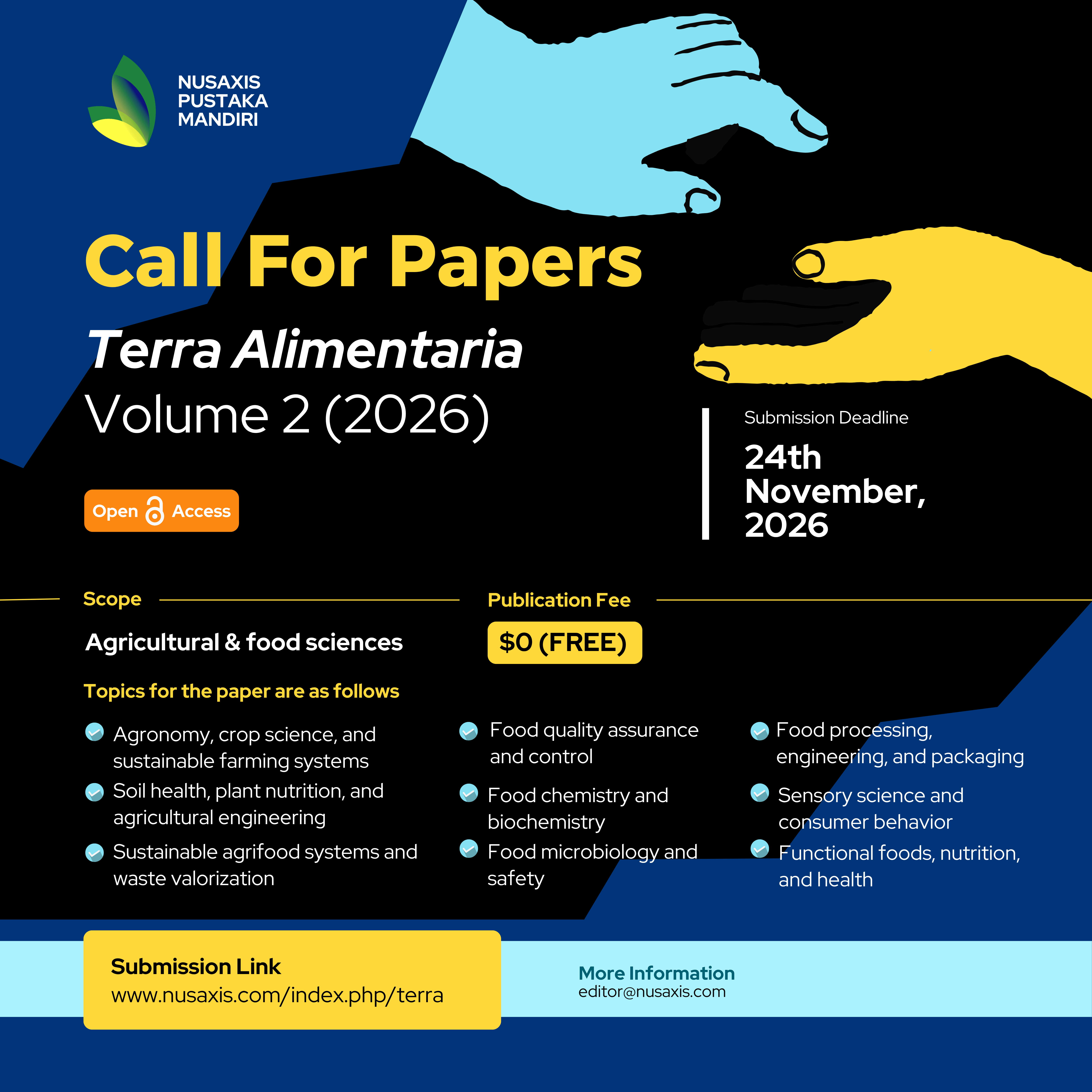
Terra Alimentaria is actively seeking high-quality submissions for our upcoming December 2026 issue.
Generative Artificial Intelligence (AI) and AI-assisted technologies—such as ChatGPT, Microsoft Copilot, Gemini, Claude, and specialized research tools—have been rapidly adopted in scholarly publishing. While they offer significant benefits, they require clear standards for responsible and transparent use.
Terra Alimentaria recognizes the potential of these tools to help researchers work efficiently. However, these tools must never be used as a substitute for human critical thinking, expertise, and evaluation. This policy provides comprehensive guidance to our authors, reviewers, and editors to ensure the integrity, confidentiality, and accuracy of the scientific record.
AI tools cannot be credited as authors. Authorship implies responsibilities and tasks that can only be attributed to and performed by humans. AI tools cannot take accountability for research design, data integrity, or the approval of the final version of the work. Furthermore, AI lacks legal standing and cannot hold or assign copyright. Each human (co-)author is fully responsible and accountable for the contents of the published work.
Authors may use AI tools to support tasks such as synthesizing literature, organizing content, or improving the language, clarity, and readability of their manuscript. However, authors must:
If authors write or edit code, or analyze data using AI tools as part of their formal research methods, this must be described in detail in the Methods section of the manuscript. The same standards for the validity and reproducibility of methodology apply whether AI assistance was used or not.
If an author uses AI Technology to substantially edit, develop, or translate any part of a manuscript, its use must be described transparently in a dedicated section at the end of the manuscript (before the References) titled "Declarations".
Suggested format for authors:
"During the preparation of this work, the author(s) used [NAME OF TOOL / SERVICE] in order to [REASON]. After using this tool/service, the author(s) reviewed and edited the content as needed and take(s) full responsibility for the content of the published article."
Exemptions: The use of basic tools that solely check spelling, grammar, or punctuation, as well as traditional reference manager functions (e.g., standard Mendeley or EndNote features) do not require disclosure. The use of specialized disability-related assistive technology also does not require disclosure.
The use of AI tools for the creation of figures, images, and artwork is heavily restricted to protect research integrity.
Authors may use AI tools to support the creation of explanatory images that illustrate concepts, processes, or relationships (e.g., flow charts, decision trees, timelines, or experimental workflows). The use of AI must be disclosed in the image caption and in the general AI disclosure statement.
Data visualizations (e.g., plots, charts, graphs, heatmaps) present results derived from underlying datasets. AI tools may be used to support their creation only when the visual output is directly derived from underlying data using reproducible analytical or statistical methods. This must be clearly reported in the Methods section. AI must never be used to invent, alter, or fabricate underlying data.
AI tools must not be used to create, enhance, or alter primary research images. This includes microscopy images, histology images, western blots, gels, radiology scans, or patient photographs. Adjustments to brightness or contrast must only be done using established image processing software in a way that does not obscure or eliminate original data.
General-purpose generative AI tools (e.g., Midjourney, DALL-E) should not be used to create graphical abstracts. Authors are highly encouraged to use dedicated scientific illustration tools (such as BioRender or Mind the Graph) which offer well-defined licensing terms and accurate scientific elements.
Peer review is at the heart of the scientific ecosystem. Submitted manuscripts are strictly confidential documents. Reviewers must not upload a submitted manuscript, or any part of it (including figures and tables), into a public AI tool. Doing so violates the authors’ confidentiality, intellectual property rights, and potentially data privacy laws, as many AI tools retain user inputs to train their models.
Reviewers remain fully responsible for the scientific assessment and judgment of the manuscripts they evaluate. AI tools cannot replace a reviewer’s critical thinking. However, reviewers may use AI tools in a supportive capacity (e.g., to improve the language and structure of their review report) provided they use a Private AI tool.
What is a private AI tool? A private tool is a version of an AI system (often paid or enterprise-level) that strictly guarantees it does not retain, re-use, share, or learn from the content submitted to it.
If reviewers use AI tools to support the writing of their report, they must include a statement directly in their "Comments to the Editor/Author".
Required format for reviewers:
"During the preparation of this report, I used [NAME OF TOOL / SERVICE, e.g., Trinka AI] solely to improve the readability and language clarity of my feedback. After using this tool, I reviewed and edited the content as needed and take full responsibility for my critical assessment, accuracy, and the integrity of this report."
Managing the editorial evaluation of a scientific manuscript implies responsibilities that can only be attributed to humans. AI tools cannot replace an editor’s critical thinking, independent evaluation, or final decision-making. Editors remain fully responsible and accountable for the editorial process and the final decision.
Like reviewers, editors must not upload submitted manuscripts, or any part of them, into public AI tools. Doing so compromises the authors' unpublished research.
Editors may use private AI tools in a supportive capacity, such as drafting or refining the language of decision letters, or assisting with background literature searches to find appropriate peer reviewers, provided that strict confidentiality is maintained and human oversight is exercised at all times.
Terra Alimentaria is actively seeking high-quality submissions for our upcoming December 2026 issue.


Terra Alimentaria is published by Nusaxis Pustaka Mandiri LLC.
Office: Perum Grand Handayani Residence Blok BB19, Gunungkidul, Special Region of Yogyakarta, Indonesia, 55651.
© 2026 Nusaxis Pustaka Mandiri LLC
NIB: 0202260114803 | Legal Entity No: AHU-007750.AH.01.30.Tahun 2026
(Registered with the Ministry of Investment and Downstream Industry & the Ministry of Law and Human Rights of the Republic of Indonesia)

Content is licensed under a Creative Commons Attribution 4.0 International License.