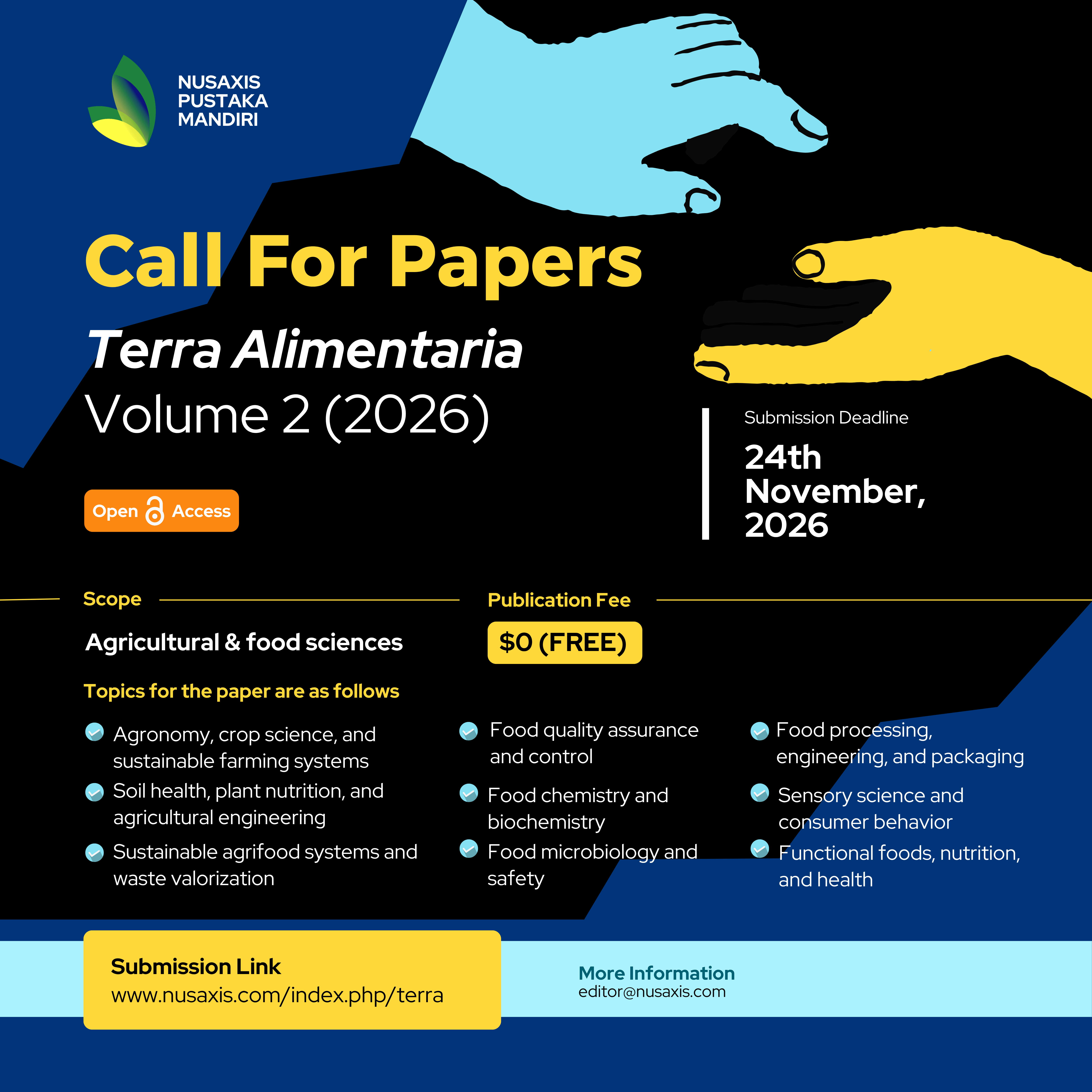
Terra Alimentaria is actively seeking high-quality submissions for our upcoming December 2026 issue.
Peer review is the foundation of scholarly publishing at Terra Alimentaria. It ensures that the research we publish meets rigorous standards of quality, credibility, and scientific integrity. This guide serves as a comprehensive resource for our reviewers, detailing best practices, ethical considerations, and step-by-step instructions for navigating the Single-Blind peer review process in our OJS 3.5 system, in compliance with COPE guidelines and Permendiktisaintek No. 9 Tahun 2026.
When invited to peer review, you will receive the manuscript's abstract to help you decide whether to accept the invitation and conduct the review. Please consider the following before responding:
As a reviewer, you must treat the manuscript and all associated data as strictly confidential. You must not share, discuss, or use the unpublished data for your own research or competitive advantage without prior authorization from the editor.
Reviewing a scientific paper requires critical human thinking, assessment, and oversight. Terra Alimentaria enforces strict guidelines regarding the use of Artificial Intelligence (AI) by peer reviewers:
"During the preparation of this work, the author(s) used Trinka AI (Enago) [or applicable tool name] solely to improve the readability and language clarity of the manuscript. After using this tool, the author(s) reviewed and edited the content as needed and take full responsibility for the accuracy, originality, and integrity of the final publication."
All review processes are managed through the Terra Alimentaria Open Journal Systems (OJS 3.5) portal. Click the link in your invitation email to log in. You will be able to view the manuscript, accept the review, type or paste your feedback into the designated text boxes, and select your final recommendation.
Your first read-through should be a quick skim to form an initial impression of the paper and give you an idea of whether your final recommendation will be to accept, revise, or reject the paper. Make notes and jot down line numbers for easier reference later.
Focus on finding major issues that could affect the manuscript’s credibility or reliability. If there are critical flaws in the methodology or data, it's very likely the manuscript will need to be rejected.
Draft the first two paragraphs of your review to help the editor contextualize your judgment:
Note: Even if you spot serious flaws, read the entire paper to ensure your initial concerns are correct and to identify any positive aspects to share with the author.
During the second detailed review, focus on refining the manuscript for publication:
The introduction should clearly set out the research argument, summarize recent literature, and highlight existing gaps in knowledge to establish the need for the research. Originality and topicality must be established using recent, authoritative research (or seminal older papers if methodologically necessary). The introduction must end with clear research aims.
Academic research should be replicable, repeatable, and robust, following best practices.
Authors should start by describing what the data show in simple terms, refer to statistical analyses (significance, goodness of fit), evaluate the trends, and explain the significance referencing published research. The discussion should gather all information into one cohesive story, addressing any gaps or inconsistencies and suggesting future research paths.
Usually a few paragraphs, the conclusions should reflect upon whether the aims were achieved. They should not introduce surprising new information. If the conclusions are not evidence-based, ask for them to be rewritten.
Check that titles, labels, and statistical notations are clear. Verify that results seem plausible, trends support the discussion, and there are sufficient data points. Check for image manipulation; if you feel an image was edited inappropriately to emphasize a story, highlight this in a confidential comment to the editor.
If you identify a very similar paper, advise the author to emphasize their novel aspects to differentiate it, or recommend rejection if it is unoriginal. If you suspect plagiarism but cannot locate the source, note this to the editor, who can utilize similarity detection software.
Your review should include comments to the authors and, if necessary, confidential comments to the editors. Write clearly, avoid complex language, and number your points referring to specific page and line numbers.
We encourage reviewers to verify whether the study follows the SAGER (Sex and Gender Equity in Research) guidelines. Assess whether sex-disaggregated data and gender analysis are included where relevant. Ensure the terms "sex" (biological distinction) and "gender" (socially constructed roles) are used correctly. If the study included only one sex/gender, ensure the authors have scientifically justified this limitation.
Ensure that research involving human or animal subjects explicitly states that it received proper ethical approval (e.g., IRB or IACUC) and informed consent. If this is missing, highlight it as a major required revision.
You will indicate your recommendation from a fixed-choice list in OJS 3.5. Be polite, honest, and objective. Never include anything in your report to the authors that you wouldn't discuss with them in person.
Reserve this section for communicating suspected malpractice such as plagiarism, fraud, unattributed work, unethical procedures, duplicate publication, bias, or inappropriate image manipulation. Authors cannot see this feedback.
Once you have submitted your review, you must continue to treat the manuscript and data as confidential until it is officially published.
Reviewer Recognition: Terra Alimentaria deeply values your contribution. After the handling editor acknowledges your submitted review, you will be able to download an official PDF Certificate of Reviewing directly from your OJS dashboard. You can also sync your peer review activity with ORCID or forward your acknowledgement email to Web of Science to build your public researcher profile.
We sincerely thank you for dedicating your time, expertise, and critical insight to Terra Alimentaria. Your efforts directly elevate the global standard of food science research.
Terra Alimentaria is actively seeking high-quality submissions for our upcoming December 2026 issue.

Terra Alimentaria is published by Nusaxis Pustaka Mandiri LLC.
Office: Perum Grand Handayani Residence Blok BB19, Gunungkidul, Special Region of Yogyakarta, Indonesia, 55651.
© 2026 Nusaxis Pustaka Mandiri LLC
NIB: 0202260114803 | Legal Entity No: AHU-007750.AH.01.30.Tahun 2026
(Registered with the Ministry of Investment and Downstream Industry & the Ministry of Law and Human Rights of the Republic of Indonesia)

Content is licensed under a Creative Commons Attribution 4.0 International License.