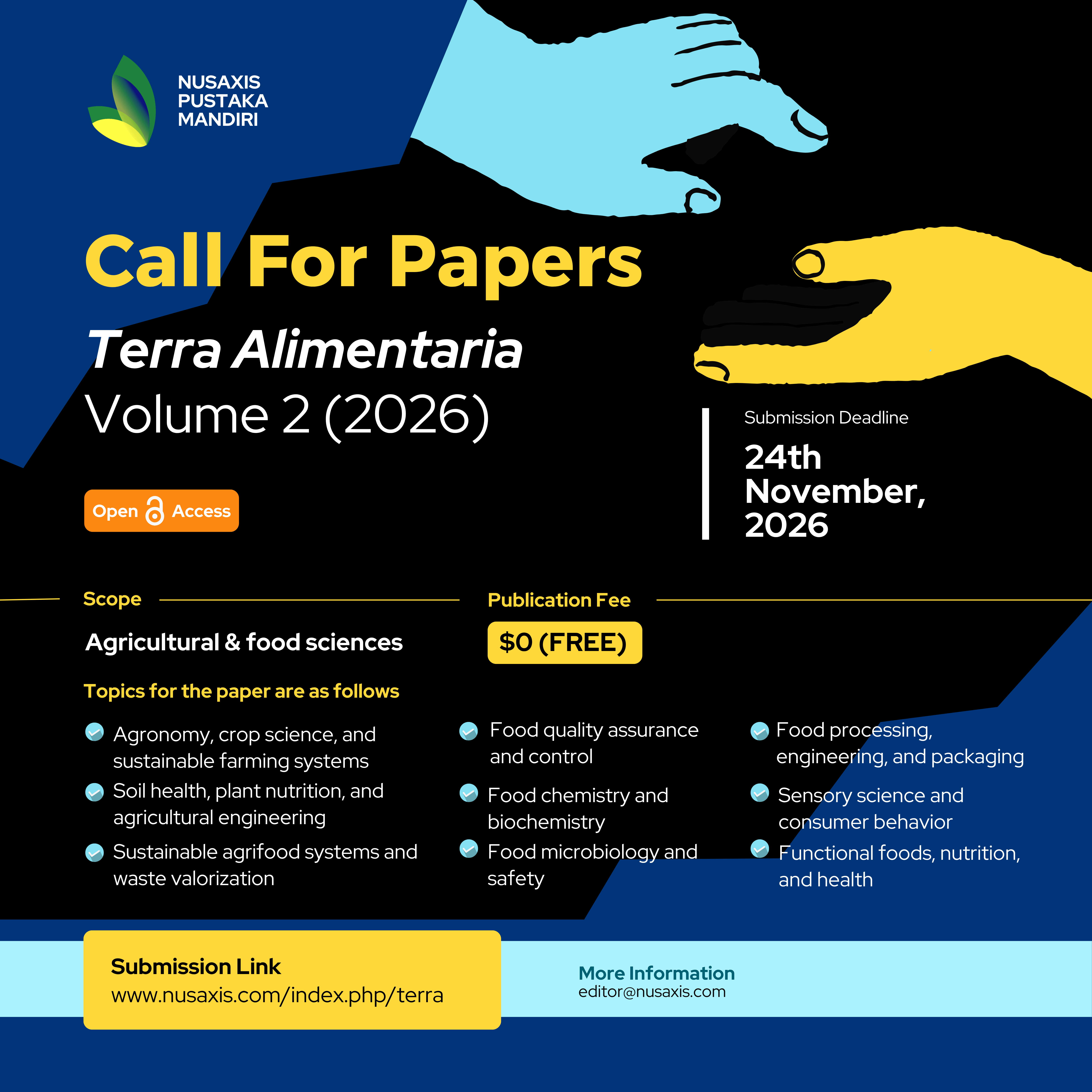
Terra Alimentaria is actively seeking high-quality submissions for our upcoming December 2026 issue.
Terra Alimentaria is committed to upholding the highest standards of scientific integrity and publication quality. To ensure the validity, relevance, and originality of the research we publish, all submitted manuscripts undergo a rigorous, transparent, and impartial evaluation process. Our peer review procedures strictly adhere to the guidelines set forth by the Committee on Publication Ethics (COPE) and comply with the national accreditation standards for scientific journals mandated by Permendiktisaintek No. 9 Tahun 2026.
Upon submission via the OJS 3.5 platform, the Editor-in-Chief or an assigned Section Editor conducts a comprehensive initial screening of the manuscript (Desk Review). This assessment is typically completed within 7 days and ensures that the submission:
Manuscripts that do not meet these fundamental criteria are rejected at this stage (Desk Reject) without being sent for external review, ensuring a rapid decision for the authors. If the assigned handling editor has a conflict of interest with the authors, they will recuse themselves, and another independent editor will be assigned.
Manuscripts that pass the initial assessment advance to a strict Single-Blind Peer Review process. In this model, the identities of the reviewers are kept strictly confidential from the authors to ensure honest, objective, and unbiased feedback. However, the reviewers are provided with the names and affiliations of the authors.
To comply with Permendiktisaintek No. 9 Tahun 2026 regarding journal quality and diversity, the editorial team carefully selects a minimum of two independent, external reviewers. Reviewer selection is based on the following criteria:
Reviewers are required to provide substantive, constructive, and detailed feedback. Check-box only reviews are not accepted. The evaluation focuses on:
Confidentiality: Following COPE guidelines, the manuscript is considered a privileged, confidential document. Reviewers are strictly prohibited from sharing, discussing, or utilizing the unpublished data for their own research purposes.
Based on the reviewers' evaluations, authors may be asked to revise their manuscript. Authors will receive the anonymized reviewer reports and are expected to:
Manuscripts requiring Minor Revisions are usually reviewed by the handling editor upon resubmission. Manuscripts requiring Major Revisions will typically be sent back to the original reviewers for a second round of evaluation to ensure all concerns have been adequately addressed.
The Editor-in-Chief (or the handling Section Editor) makes the final publication decision based on the comprehensive reviewer reports and the authors' revisions. If the two initial reviewers' opinions differ significantly (e.g., one recommends acceptance, the other rejection), a third independent reviewer will be invited to provide an adjudicating assessment.
The final decision will be one of the following:
Strict Prohibition of Guaranteed Acceptance and Premature LoAs: Terra Alimentaria strictly adheres to merit-based publishing. Under no circumstances do we guarantee or promise fast-tracked acceptance of any manuscript. Furthermore, the issuance of a Letter of Acceptance (LoA) prior to the full completion of the rigorous peer-review process and a formal editorial decision of "Accept Submission" is strictly prohibited and will not be tolerated. Any claims of guaranteed publication are fraudulent and a severe breach of publication ethics.
To ensure absolute impartiality, any manuscript submitted by the Editor-in-Chief, an Associate Editor, or an Editorial Board Member is handled by an independent editor who is entirely separate from the submitting author. The submitting editor is completely blinded from the review process in the OJS system and has no access to the reviewer identities or the decision-making workflow for their own paper.
In adherence to COPE practices, authors have the right to appeal an editorial rejection if they believe the decision was based on a fundamental scientific misunderstanding or procedural error. Appeals must be submitted via email to the Editorial Office with a detailed, evidence-based rebuttal letter. The Editor-in-Chief (or an assigned independent adjudicator) will review the appeal and make a final, non-reversible determination.
Terra Alimentaria strives to provide an efficient and timely review process while maintaining rigorous quality control. Authors can track the status of their manuscript at any time via their OJS 3.5 dashboard.
Terra Alimentaria is actively seeking high-quality submissions for our upcoming December 2026 issue.

Terra Alimentaria is published by Nusaxis Pustaka Mandiri LLC.
Office: Perum Grand Handayani Residence Blok BB19, Gunungkidul, Special Region of Yogyakarta, Indonesia, 55651.
© 2026 Nusaxis Pustaka Mandiri LLC
NIB: 0202260114803 | Legal Entity No: AHU-007750.AH.01.30.Tahun 2026
(Registered with the Ministry of Investment and Downstream Industry & the Ministry of Law and Human Rights of the Republic of Indonesia)

Content is licensed under a Creative Commons Attribution 4.0 International License.