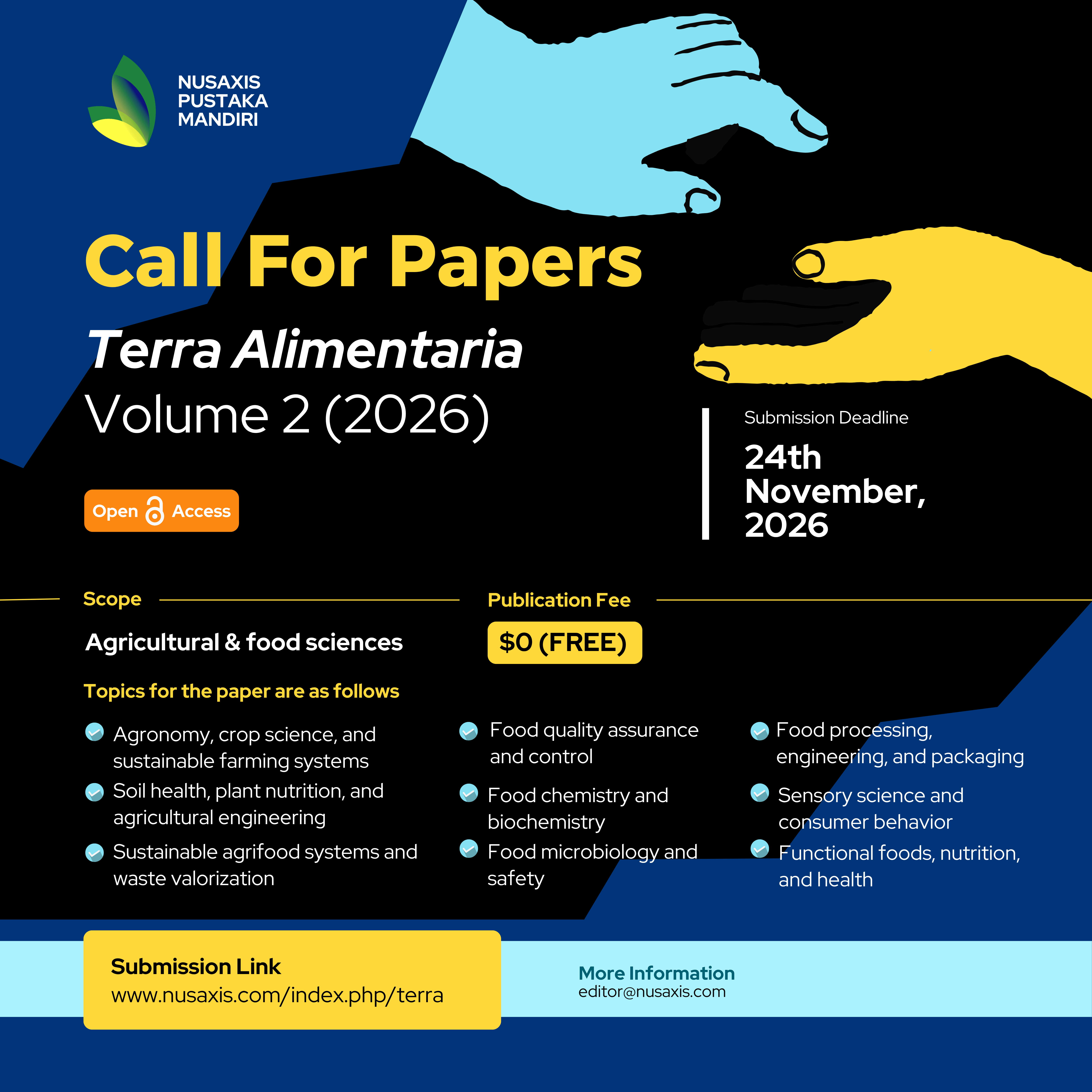
Terra Alimentaria is actively seeking high-quality submissions for our upcoming December 2026 issue.
Terra Alimentaria is dedicated to publishing research that meets the highest ethical standards. Appropriate consents, permissions, and releases regarding personal information, human participants, and animal subjects are strictly required. Authors must ensure that all research is conducted responsibly, safely, and in compliance with relevant institutional, national, and international guidelines.
If the work involves human participants, living or deceased, including their data and/or biological materials (e.g., organs, tissues, or sensory panel evaluations), the author must ensure that all studies were performed in compliance with relevant laws, regulations, and institutional guidelines, and that the appropriate institutional committee(s) has/have approved them.
Authors must include a statement in the manuscript that confirms these requirements have been met. The statement must contain the date and reference number of the ethical approval(s) obtained. Research involving human participants must be carried out in accordance with the World Medical Association Declaration of Helsinki and any other guidelines specific to the relevant discipline.
Informed consent must be obtained for research with human participants, including their data or biological materials. Consent must be given without coercion, and the privacy rights of human participants must always be observed. Authors must include a statement in the manuscript confirming that they obtained informed consent from all participants (or their parent, guardian, or legal representative where applicable). Consent for publication must also be obtained.
Appropriate written consents, permissions, and releases must be obtained where an author wishes to include case details, videos, recordings, images, photographs, and illustrations of individuals in a Terra Alimentaria publication. Written consents must be retained by the author, and evidence that such consents have been obtained must be provided to the editorial office upon request.
For research where only verbal informed consent was obtained, authors must include justification for the absence of written consent, the name of the approving ethics committee, and a statement on how verbal consent was recorded. Authors should be aware that written consent is required for certain studies under national laws, including clinical nutrition trials, case studies, studies with vulnerable populations, and studies containing personally identifiable data.
Authors must ensure that appropriate consents and safeguards are in place for research with vulnerable populations, including but not limited to children, refugees, Indigenous peoples, marginalized groups, persons with disabilities, older adults, and any persons lacking the capacity to consent.
In many countries, additional ethical approval is needed for research with those who lack the capacity to consent. It is the responsibility of the author to ensure that all laws are followed and that written consent was obtained from the participants’ Legal Representatives. Where possible, participants should also give their assent to be included in the research. A statement must be included in the manuscript detailing that the necessary safeguards were in place.
For all studies that use human organs or tissues, sufficient evidence must be provided that these were procured in line with the WHO Guiding Principles on Human Cell, Tissue and Organ Transplantation. The source of the materials must be transparent and traceable. If a manuscript describes such research, authors must declare that autonomous consent free from coercion was obtained from the donor(s) or their next of kin, and that tissues were ethically sourced.
All studies involving human participants require an ethical statement (including consumer surveys, sensory evaluation studies, and case reports). If ethical approval is not required by national laws, or where a study has been granted an exemption from an ethics committee, the statement in the manuscript must explicitly explain why the study is exempt and confirm that appropriate protocols for protecting the rights and privacy of all participants were utilized (e.g., no coercion, full disclosure of risks, data anonymity).
Appropriate written consents must be obtained to comply with all applicable Data Protection and Privacy Laws (e.g., GDPR, HIPAA) when publishing identifiable images or information.
Care should be taken to de-identify participant-specific information.
All animal experiments must comply with the ARRIVE (Animal Research: Reporting of In Vivo Experiments) guidelines (or national equivalent) and must be carried out in accordance with relevant laws and associated guidelines for animal welfare. This includes guidelines from the National Research Council Guide for the Care and Use of Laboratory Animals or equivalent internationally recognized bodies.
Authors must ensure that the manuscript contains a statement confirming which guidelines have been followed. This statement must include the ethics committee approval number. If a study was granted exemption or did not require ethics approval, a detailed statement explaining the exemption must be included.
The sex of animals, and where appropriate, the influence (or association) of sex on the results of the study should be explicitly indicated in the methodology and results sections.
Where applicable, researchers are required to document informed consent from the client or owner in studies involving client-owned animals and adhere to best practices of veterinary care. For research on threatened and/or endangered species (e.g., novel food sources harvested from the wild), authors are advised to consult international best practice guidelines such as the IUCN Red List guidelines and must provide evidence of appropriate collection permits.
Terra Alimentaria is actively seeking high-quality submissions for our upcoming December 2026 issue.

Terra Alimentaria is published by Nusaxis Pustaka Mandiri LLC.
Office: Perum Grand Handayani Residence Blok BB19, Gunungkidul, Special Region of Yogyakarta, Indonesia, 55651.
© 2026 Nusaxis Pustaka Mandiri LLC
NIB: 0202260114803 | Legal Entity No: AHU-007750.AH.01.30.Tahun 2026
(Registered with the Ministry of Investment and Downstream Industry & the Ministry of Law and Human Rights of the Republic of Indonesia)

Content is licensed under a Creative Commons Attribution 4.0 International License.