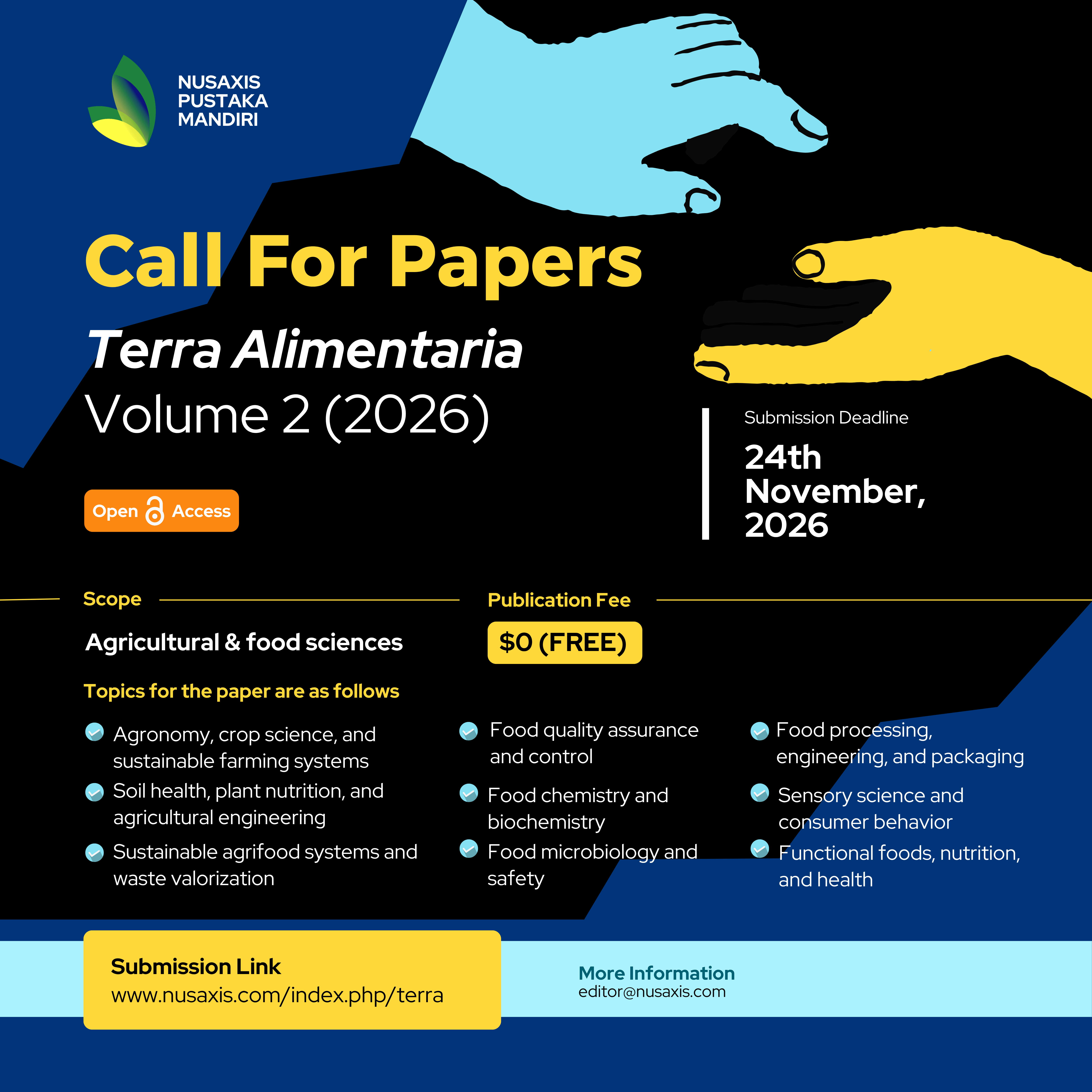
Terra Alimentaria is actively seeking high-quality submissions for our upcoming December 2026 issue.
Terra Alimentaria recognizes the critical importance of the integrity and completeness of the scholarly record to the scientific community and attaches the highest importance to maintaining trust in the authority of its published articles. As a general principle, articles that have been published shall remain extant, exact, and unaltered as far as is possible. However, circumstances may arise where an article needs to be corrected, retracted, or even removed.
It is a fundamental principle of scholarly communication that the Editor-in-Chief of a learned journal is solely and independently responsible for deciding which articles submitted to the journal shall be published. An outcome of this principle is the importance of the scholarly record as a permanent and historic record of the transactions of scholarship. Therefore, when the scientific record requires correction, this will be made by a formal notice that will be permanently linked to the article, providing transparency for the scientific community.
This policy describes Terra Alimentaria's approach to correcting the scientific record in our Open Journal Systems (OJS) platform. It is periodically reviewed and updated as standards and best practices evolve.
Authors who discover a significant error or inaccuracy in their published article must contact the journal’s editorial office as soon as possible.
In most cases, the corresponding author will be responsible for sharing the details of the error with the journal. The Editor-in-Chief, or a designated representative with appropriate subject matter expertise, will review the proposed correction together with any accompanying data. They may send the proposed correction for further peer review. The Editor-in-Chief will determine the appropriate mechanism to correct the article in consultation with the Editorial Board.
Editor’s Notes may be issued in circumstances that do not warrant a full retraction, correction, or expression of concern. They alert readers to elements within a published article that do not impact the results and conclusions of the article, but where Editors wish to advise readers to exercise a degree of caution. For example, an Editor’s Note may be warranted if:
An Expression of Concern alerts readers to potential concerns that might affect the reliability of parts or all of a published work. The Editor-in-Chief, in consultation with the Editorial Board, will consider issuing an Expression of Concern if any of the following conditions are met:
An Expression of Concern remains part of the permanent record. If an investigation is definitively resolved, the editor will publish a notice—such as a correction, retraction, or editorial note—that explains the outcome. The original Expression of Concern will not be removed but may be updated to reflect the resolution.
Articles-in-Press (or "Early View" articles) represent early, accepted versions of articles that have not yet been published in their final issue form. They may only be withdrawn if:
When Articles-in-Press are withdrawn for these reasons, the article content (HTML and PDF) will be removed and replaced with a notice stating that the article has been withdrawn according to the Terra Alimentaria Article Withdrawal Policy.
The retraction of an article is a mechanism to correct the literature and alert readers to publications that contain such seriously flawed or erroneous data that their findings and conclusions cannot be relied upon. Articles may be retracted to correct severe errors or due to infringements of publishing ethics.
The Editor-in-Chief will consider retracting an article where:
In accordance with industry best practices, Terra Alimentaria handles retractions as follows:
In an extremely limited number of cases, it may be necessary to completely remove an article from the online archive. Given the importance of maintaining the scholarly record as a permanent and unaltered archive, actual removal of an article's content is exceptionally rare and will only occur where it is determined that:
In these circumstances, the metadata (Title and Authors) will be retained on the journal website, but the full text and PDF will be removed and replaced with a notice indicating the article has been removed for legal or safety reasons.
In cases where an article, if acted upon, might pose a serious health risk, the authors may wish to retract the original flawed article and replace it with a corrected version. In these circumstances, the standard procedures for retraction will be followed, with the difference that the retraction notice will publish a direct link to the newly corrected and re-published article alongside a history of the document.
To ensure the long-term preservation of the scholarly record, Terra Alimentaria utilizes the PKP Preservation Network (PKP PN) and national archiving databases (such as Garuda or the National Library of Indonesia) to securely retain all article versions, including those that have been retracted.
Terra Alimentaria is actively seeking high-quality submissions for our upcoming December 2026 issue.

Terra Alimentaria is published by Nusaxis Pustaka Mandiri LLC.
Office: Perum Grand Handayani Residence Blok BB19, Gunungkidul, Special Region of Yogyakarta, Indonesia, 55651.
© 2026 Nusaxis Pustaka Mandiri LLC
NIB: 0202260114803 | Legal Entity No: AHU-007750.AH.01.30.Tahun 2026
(Registered with the Ministry of Investment and Downstream Industry & the Ministry of Law and Human Rights of the Republic of Indonesia)

Content is licensed under a Creative Commons Attribution 4.0 International License.