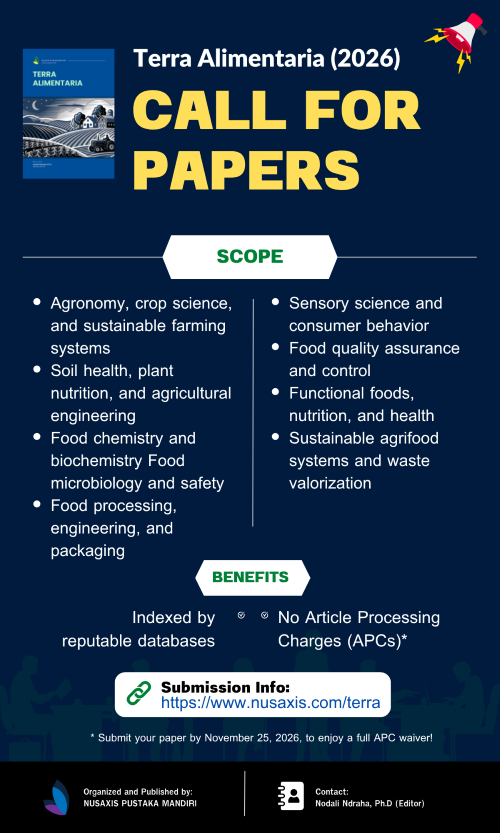
Terra Alimentaria is actively seeking high-quality submissions for our upcoming November 2026 issue.
Terra Alimentaria enforces a strict zero-tolerance policy on plagiarism and academic misconduct. In accordance with the Committee on Publication Ethics (COPE) guidelines and the national journal accreditation standards (Permendiktisaintek No. 9 Tahun 2026), all submitted manuscripts are rigorously screened for originality before they are allowed to proceed to peer review.
To ensure the originality of published work, the editorial board evaluates all incoming manuscripts using Turnitin / iThenticate similarity detection software.
Maximum Acceptable Similarity Index
The overall similarity index must be less than 25%. Furthermore, the similarity from any single distinct source must not exceed 5%.
Note: During the screening process, the software is configured to exclude the bibliography/reference list, properly enclosed quotations, and minor matches of fewer than 7 words.
Terra Alimentaria considers the following acts to be severe academic misconduct:
If plagiarism or excessive similarity is detected, the editorial board will take the following actions based on the severity:
If severe plagiarism is discovered after an article has been published, Terra Alimentaria will follow the COPE Retraction Guidelines. The article will be formally retracted, and a retraction notice will be permanently attached to the article's digital footprint (DOI). Please refer to our Article Correction, Retraction & Removal Policy for more details.
Terra Alimentaria is actively seeking high-quality submissions for our upcoming November 2026 issue.

Terra Alimentaria is published by Nusaxis Pustaka Mandiri LLC.
Office: Perum Grand Handayani Residence Blok BB19, Gunungkidul, Special Region of Yogyakarta, Indonesia, 55651.
© 2026 Nusaxis Pustaka Mandiri LLC
NIB: 0202260114803 | Legal Entity No: AHU-007750.AH.01.30.Tahun 2026
(Registered with the Ministry of Investment and Downstream Industry & the Ministry of Law and Human Rights of the Republic of Indonesia)

Content is licensed under a Creative Commons Attribution 4.0 International License.