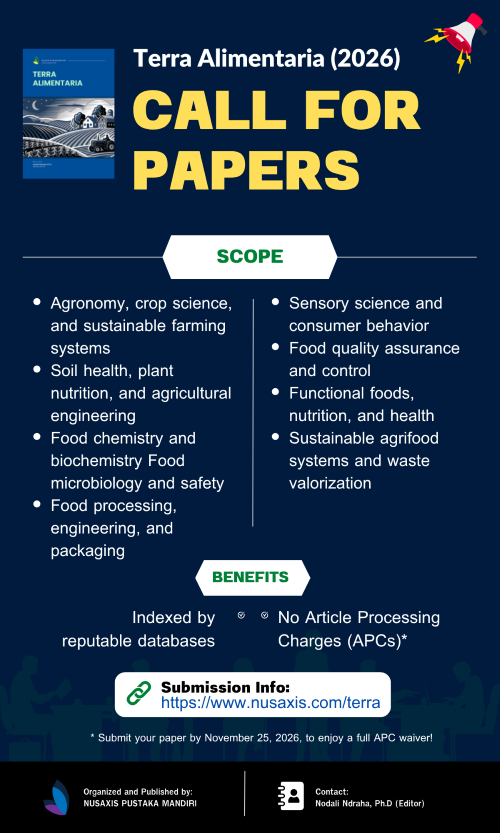
Terra Alimentaria is actively seeking high-quality submissions for our upcoming November 2026 issue.
Terra Alimentaria is dedicated to maintaining the highest standards of professional ethics, accuracy, and quality in all matters related to handling manuscripts and reporting scientific information.
Terra Alimentaria offers scientists an international forum to publish research at the forefront of agricultural and food sciences. The journal publishes peer-reviewed articles covering all aspects from farm to fork. For full details, please see our Aims and Scope.
The core areas of interest include, but are not limited to:
Terra Alimentaria provides immediate open access to its content on the principle that making research freely available to the public supports a greater global exchange of knowledge. Read our full Open Access Policy.
The journal publishes continuously, with articles compiled into issues biannually. Accepted articles are published online as soon as they are ready, ensuring rapid dissemination of research findings. View our Publication Frequency details.
For complete details regarding our current APCs, payment processes, and our waiver policy for authors experiencing financial hardship or from low-income countries, please see our dedicated Author Fees page.
To foster a comprehensive dialogue within the agricultural and food science community, Terra Alimentaria welcomes the following types of submissions. Authors must clearly indicate the intended manuscript type upon submission in the OJS platform.
Detailed studies presenting primary, novel findings that significantly advance the field from farm to fork. The research must be scientifically robust, methodologically sound, and provide new insights.
Authoritative and critical overviews of current topics, synthesizing existing literature to provide new insights. We do not accept mere summaries of literature; reviews must identify research gaps and propose future directions. Systematic reviews must adhere to PRISMA guidelines.
Forward-looking pieces that discuss emerging trends, policy implications, or future directions in agriculture and food technology. All claims must be evidence-based and supported by peer-reviewed literature.
We are committed to ensuring ethics in publication and quality of articles. Plagiarism, data fabrication, and image manipulation are strictly prohibited. Please read our complete Ethics in publishing guidelines.
Submission of an article implies that the work described has not been published previously and is not under consideration for publication elsewhere. Authors must verify originality; the editorial team utilizes Turnitin/iThenticate similarity detection.
Authorship requires meeting ICMJE criteria. All authors' CRediT contributions must be added during OJS submission. Ghost, guest, or honorary authorship is prohibited. Please see our full Authorship and Contributorship Policy. Changes to authorship (addition, deletion, or rearrangement) must be requested before manuscript acceptance and require the Editor's approval along with written consent from all original authors.
Inclusive language acknowledges diversity, conveys respect to all people, is sensitive to differences, and promotes equal opportunities. Authors should ensure their work uses inclusive language throughout and contains nothing which might imply one individual is superior to another on the grounds of age, gender, race, ethnicity, culture, sexual orientation, disability, or health condition. We recommend avoiding the use of descriptors about personal attributes unless they are relevant and valid. Write for gender neutrality with the use of plural nouns ("clinicians, patients/clients") as default. Wherever possible, avoid using "he, she," or "he/she." No assumptions should be made about the beliefs of readers and writing should be free from bias, stereotypes, slang, reference to dominant culture and/or cultural assumptions. These guidelines are meant as a point of reference to help you identify appropriate language but are by no means exhaustive or definitive.
There is no single, universally agreed-upon set of guidelines for defining sex and gender. We offer the following guidance:
We advise you to read the Sex and Gender Equity in Research (SAGER) guidelines and the SAGER checklist, which offer systematic approaches to the use of sex and gender information in study design, data analysis, outcome reporting and research interpretation.
We ask authors to define how sex and gender have been used in their research and publication. Some guidance:
Depending on the focus of a paper, sex and/or gender may or may not be relevant to the content of the paper. We recognize that beliefs, attitudes, and laws relating to sex and gender may vary. These articles do not attempt to dictate author beliefs but rather require that, where relevant to an author’s research or paper, the author must provide clear explanations of how the paper and research define and use sex and gender.
We accept that authors sometimes need to adjust images for clarity but any manipulation of images for the purpose of deception or fraud will be seen as scientific ethical abuse and will be dealt with accordingly. Authors must adhere to this journal’s policy for graphical images:
To verify compliance with the above, this journal may send your images to a secure third-party tool to enable screening for image irregularities. Our editors may ask you to provide original data or images if any questions arise as a result of the screening. The final decision as to whether images are acceptable will be taken by our editors. Authors are encouraged to carefully check all images before submission and to connect all the data in any figures to the original, unprocessed data.
Terra Alimentaria respects the decisions taken by its authors as to how they choose to designate territories and identify their affiliations in their published content. Our policy is to take a neutral position with respect to territorial disputes or jurisdictional claims, including, but not limited to, maps and institutional affiliations.
Authors must follow ethical guidelines for research involving humans, their data, and/or their biological materials (e.g. organs, tissues). Authors should ensure that they adhere to the following:
For all studies that use human organs or tissues, sufficient evidence must be provided that these were procured in line with WHO Guiding Principles on Human Cell, Tissue and Organ Transplantation. The source of the organs or tissues used in clinical research must be transparent and traceable and must not be sourced from executed prisoners or prisoners of conscience. For clinical studies, a statement of informed consent having been obtained from a patient or their legal representative, paired with ethical approval for the study from a suitable institution, may be considered sufficient evidence, but the journal reserves the right to request additional evidence. If the manuscript describes organ transplantation authors must additionally declare within the manuscript that autonomous consent, free from coercion, was obtained from the donor(s) or their next of kin, and organs and/or tissues were not sourced from executed prisoners or prisoners of conscience.
All animal experiments should comply with the ARRIVE (Animal Research: Reporting of In Vivo Experiments) guidelines (or national equivalent) and should be carried out in accordance with relevant laws and associated guidelines for animal welfare. Authors must ensure that the manuscript contains a statement that confirms which guidelines have been followed. This statement should include the ethics committee approval number, when available. If a study was granted exemption or did not require ethics approval, a statement detailing this should be included in the manuscript. The sex of animals, and where appropriate, the influence (or association) of sex on the results of the study should be indicated. Where applicable, researchers are encouraged to document informed consent from the client or owner in studies involving client-owned animals and adhere to best practices of veterinary care. For research on threatened and/or endangered species, authors are advised to consult international best practice guidelines (e.g., IUCN).
If you need to delay the publication of your article for any reason, please contact the editorial office of the journal at the earliest possible opportunity. While we will try to ensure that your article is not published before a certain date if you make your request on a timely basis, we cannot guarantee this. Please also note that once the agreed period of delay has expired the article may be published at any time thereafter.
For questions about article withdrawal, correction, or retraction, please consult our editorial policies regarding article correction, retraction, and removal.
Terra Alimentaria is committed to upholding the highest standards of academic integrity. All research and review articles submitted to the journal undergo a rigorous Single-Blind Peer Review process by independent, expert referees to ensure the validity, relevance, and scientific rigor of the work.
In a single-blind review model, the reviewers know the identities of the authors, but the authors do not know who reviewed their manuscript. Because of this, you do not need to anonymize your main document or strip identifying information prior to submission. Please see our Peer Review Process page for full details.
We ask you to provide editable source files for your entire submission (including figures, tables and text graphics). Some guidelines:
You are required to include the following details on the title page:
You are required to provide a concise and factual abstract which does not exceed 250 words. The abstract should briefly state the purpose of your research, principal results and major conclusions. Some guidelines:
You are required to provide 1 to 7 keywords for indexing purposes. Keywords should be written in English. Please try to avoid keywords consisting of multiple words (using "and" or "of"). We recommend that you only use abbreviations in keywords if they are firmly established in the field.
You are required to provide article highlights at submission. Highlights are a short collection of bullet points that should capture the novel results of your research as well as any new methods used during your study. Highlights will help increase the discoverability of your article via search engines. Some guidelines:
This journal requires you to use the international system of units (SI) which follows internationally accepted rules and conventions. If other units are mentioned within your article, you should provide the equivalent unit in SI.
Tables must be submitted as editable text, not as images. Some guidelines:
Figures, images, diagrams and other graphical media (artwork) must be supplied as separate files along with the manuscript. When submitting artwork:
Captions: All artwork must have a caption. A caption should consist of a brief title (not displayed on the figure itself) and a description of the image. Keep the amount of text to a minimum, though any symbol or abbreviation should be explained.
Formats: Submit your artwork in the formats listed below:
| Image type | Recommended file type | Requirements |
|---|---|---|
| Vector drawings | EPS, PDF | Embed the font or save text as graphics |
| Photographs (color or grayscale) | TIFF, JPG, PNG | Minimum resolution 300 dpi |
| Bitmapped line drawings | TIFF, JPG, PNG | Minimum resolution 1000 dpi |
| Charts and large or shaded tables | XLS, XLSX | Supply in a clearly readable format |
| Annotated images | PPT, PPTX | Annotations and text must be legible; Min. resolution 300 dpi |
Do not submit files that are too low in resolution, artwork where text is disproportionately small, or multiple images/graphs combined into one file (unless they share a direct relationship, such as before/after photos).
Color artwork: If you submit usable color figures, they will appear in color online. Please ensure that color images are accessible to all, including those with impaired color vision.
Generative AI and figures: Please read our Artificial Intelligence (AI) Policy regarding images and artwork. AI tools may be used to support explanatory images (flow charts) or data visualizations (plots derived from underlying data using reproducible methods). AI tools must not be used to create or alter images that represent primary observed or experimental data (western blots, microscopy, etc.).
We encourage the use of supplementary materials such as applications, images and sound clips to enhance research. Supplementary material should be accurate and relevant to the research. Cite all supplementary files in the manuscript text and submit all materials at the same time as your manuscript. Include a concise, descriptive caption for each file. Be aware that all supplementary materials provided will appear online in the exact same way as received and will not be checked or formatted by the production team.
This journal accepts video material and animation sequences to support and enhance your scientific research. When including video or animation file links within your article, refer to the video or animation content by adding a note in your text where the file should be placed. Provide files in recommended formats with a preferred maximum file size of 150 MB per file, 1 GB in total. Provide "stills" for each of your files and descriptive text in your manuscript to refer to the video content.
Research data refers to the results of observations or experimentation that validate research findings, which may also include software, code, models, algorithms, protocols, methods and other useful materials related to the project. You are required to:
Data statement: To foster transparency, you are required to state the availability of any data at submission. If your data is unavailable to access or unsuitable to post (e.g., sensitive or confidential information), you can state the reason why during the submission process.
Data linking: If your research data has been made available in a data repository, provide a link to your dataset when prompted during the online submission process. You can also link relevant data or entities within the text of your article through the use of identifiers (e.g. Database: 12345).
You are encouraged to publish a description of your research data, methods, or protocols related to your regular article as a co-submission article in relevant data journals (e.g., Data in Brief or MethodsX). This co-submission can be submitted at the same time as your regular manuscript via the OJS portal.
All manuscripts must include the following sections to provide transparency.
Nonhuman technologies (AI/LLMs) cannot qualify as authors. AI use for language editing or drafting must be explicitly disclosed here. See our Artificial Intelligence (AI) Policy. Example: "During the preparation of this work, the author(s) used Trinka AI solely to improve readability and language clarity. The author(s) take full responsibility for the accuracy and originality of the final publication."
Corresponding authors are required to acknowledge co-author contributions using CRediT (Contributor Roles Taxonomy) roles:
Not all CRediT roles will apply to every manuscript and some authors may contribute through multiple roles.
Disclose any financial or professional affiliations (within 3 years) that might be perceived as a conflict of interest. Example: "The authors declare that they have no known competing financial interests or personal relationships that could have appeared to influence the work reported in this paper."
Identify all financial support. Example: "This work was supported by the Ministry of Education, Culture, Research, and Technology of the Republic of Indonesia under Grant [number]."
State where supporting data can be found. Example: "The data presented in this study are available on reasonable request from the corresponding author."
Any references cited in your article should also be present in your reference list and vice versa. Some guidelines:
Citations in the text should follow the referencing style used by the American Psychological Association. You are referred to the Publication Manual of the American Psychological Association, Seventh Edition (2020) ISBN 978-1-4338-3215-4. The reference list should be arranged alphabetically and then chronologically. More than one reference from the same author(s) in the same year must be identified by the letters 'a', 'b', 'c', etc., placed after the year of publication.
Examples:
When listing web references, as a minimum you should provide the full URL and the date when the reference was last accessed. Additional information (e.g. DOI, author names, dates or reference to a source publication) should also be provided, if known.
We encourage you to cite underlying or relevant datasets within article text and to list data references in the reference list. When citing data references, you should include: author name(s), dataset title, data repository, version (where available), year, and global persistent identifier. Add [dataset] immediately before your reference. This will help us to properly identify the dataset. The [dataset] identifier will not appear in your published article.
We ask you to mark preprints clearly. You should include the word "preprint" or the name of the preprint server as part of your reference and provide the preprint DOI. Where a preprint has subsequently become available as a peer-reviewed publication, use the formal publication as your reference.
Most journals have their reference template available in popular reference management software products. These include products that support Citation Style Language (CSL) such as Mendeley Reference Manager. If you use a citation plug-in from these products, select the relevant journal template and all your citations and bibliographies will automatically be formatted in the journal style. We advise you to remove all field codes before submitting your manuscript to any reference management software product.
Before completing the submission of your manuscript, we advise you to read our submission checklist:
Our online submission system guides you through the process steps of entering your manuscript details and uploading your files. The system or an editor converts your article files to a single PDF file used in the peer-review process. Editable files (e.g., Word, LaTeX) are required to typeset your article for final publication. All correspondence, including notification of the editor's decision and requests for revision, is sent by email via the Terra Alimentaria OJS portal.
If your manuscript is more suitable for an alternative journal, you may receive an email asking you to consider transferring your manuscript via our Article Transfer Service. If you agree with the recommendation, your manuscript will be transferred and independently reviewed by the editors of the new journal.
Authors will be asked to complete a publishing agreement after acceptance. The corresponding author will receive a link to the online agreement by email. We advise you to read our policies related to copyright to learn more about our copyright policies and your, and your employer’s/institution’s, additional rights for open access articles.
Authors will be offered open access user license options which will determine how you, and third parties, can reuse your open access article. We advise that you review these options and any funding body license requirements before selecting a license option.
If excerpts from other copyrighted works are included in your article, you must obtain written permission from the copyright owners and credit the source(s) within your article.
We encourage you to share and promote your article to give additional visibility to your work, enabling your paper to contribute to scientific progress and foster the exchange of scientific developments within your field.
We recommend that you write in American or British English but not a combination of both. If you feel the English language in your manuscript requires editing to eliminate possible grammatical or spelling errors and to conform to correct scientific English, you may wish to use professional English Language Editing services prior to submission.
Terra Alimentaria is actively seeking high-quality submissions for our upcoming November 2026 issue.

Terra Alimentaria is published by Nusaxis Pustaka Mandiri LLC.
Office: Perum Grand Handayani Residence Blok BB19, Gunungkidul, Special Region of Yogyakarta, Indonesia, 55651.
© 2026 Nusaxis Pustaka Mandiri LLC
NIB: 0202260114803 | Legal Entity No: AHU-007750.AH.01.30.Tahun 2026
(Registered with the Ministry of Investment and Downstream Industry & the Ministry of Law and Human Rights of the Republic of Indonesia)

Content is licensed under a Creative Commons Attribution 4.0 International License.