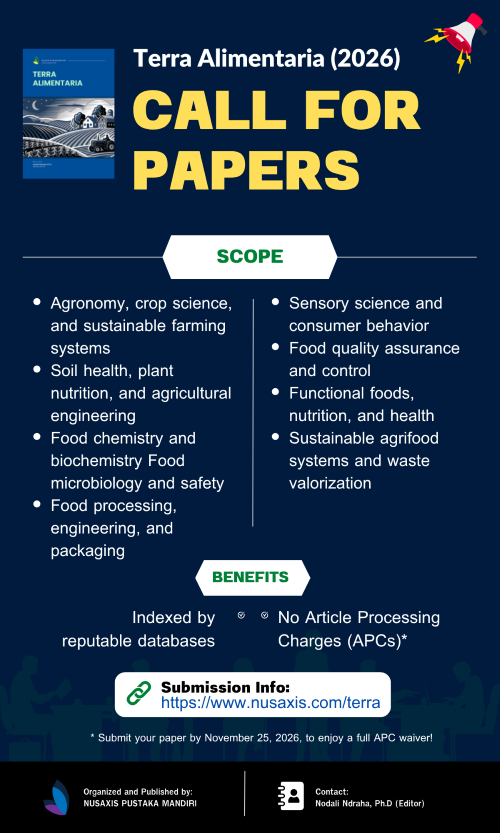
Terra Alimentaria is actively seeking high-quality submissions for our upcoming November 2026 issue.
In accordance with the Committee on Publication Ethics (COPE) Core Practices, Terra Alimentaria requires all participants in the publication process—authors, peer reviewers, and editorial board members—to transparently declare any potential Conflicts of Interest (COI).
A conflict of interest exists when professional judgment concerning the validity of research is influenced by a secondary interest, such as financial gain, personal relationships, or academic rivalry.
All authors must disclose any financial or non-financial conflicts of interest that occurred within the last 3 (three) years related to the submitted work.
To maintain the absolute integrity of our single-blind and double-blind peer-review processes, reviewers must recuse themselves from evaluating a manuscript if they recognize the work and identify a conflict of interest.
Reviewers must decline the review invitation (or contact the handling editor immediately) if they:
Editorial independence is strictly enforced. Editors will not handle the peer review or make acceptance/rejection decisions for manuscripts where they have a conflict of interest (e.g., papers submitted by colleagues from their own institution, or papers where they are listed as a co-author).
Submissions by Editorial Board Members: If an Editor-in-Chief, Managing Editor, or Editorial Board Member submits a manuscript to Terra Alimentaria, they are completely blinded to the review process of their own paper. The manuscript will be assigned to an independent Guest Editor or a different Editorial Board member to manage the peer review and final decision, ensuring a completely unbiased evaluation.
If an undisclosed conflict of interest is discovered after a manuscript has been published, the journal will follow COPE protocols to investigate. Depending on the severity of the undeclared conflict, this may result in the publication of an official Corrigendum, Expression of Concern, or full Article Retraction.
Terra Alimentaria is actively seeking high-quality submissions for our upcoming November 2026 issue.

Terra Alimentaria is published by Nusaxis Pustaka Mandiri LLC.
Office: Perum Grand Handayani Residence Blok BB19, Gunungkidul, Special Region of Yogyakarta, Indonesia, 55651.
© 2026 Nusaxis Pustaka Mandiri LLC
NIB: 0202260114803 | Legal Entity No: AHU-007750.AH.01.30.Tahun 2026
(Registered with the Ministry of Investment and Downstream Industry & the Ministry of Law and Human Rights of the Republic of Indonesia)

Content is licensed under a Creative Commons Attribution 4.0 International License.